PARAM ScienceLight & Sound
PARAM Science November 2026

Light & Sound

Beyond what we learn in school, both have a few tricks up their sleeves.

Scroll

Masthead

Editor in Chief
Ganesh P
Executive Editor
Anupama H
Digital Designer
Abhiram S
Visual Designer
Abhiram S
Pramodh R (When Dasara Went Digital)
Researchers and Writers
Bhavana Umesh
Geetha Gurrappa
Riya Pradhan

Editorial Note

Darkness is the absence of light and silence is the absence of sound.

All the four elements symbolise many things around the world. We live in an era where sound and light can be conjured like magic. To think that there was a time not too long ago where light and sound were only in their natural element is bizarre. As we celebrate the festival of light this month, we can only be grateful for the almost magical times we live in.

Before you begin

This issue is best heard.

A low, warm drone plays while you read. Turn it off anytime with the dotted circle.

Article 01 · Four curiosities

Beyond what we see and hear

We see light and hear sound every day, often without giving them much thought. But beyond what we learn in school, both have a few tricks up their sleeves. The more we explore them, the more surprising things we find.

  1. 1 The shrimp with a bubble gun
  2. 2 A phone call on a sunbeam
  3. 3 Krakatoa: The sound that went around the world
  4. 4 When light slows to a crawl

The shrimp with a bubble gun

Tap to snap againSnap, jet, bubble, collapse, flash, pressure wave

The pistol shrimp has a rather unusual way of hunting. It uses one of its claws to create a bubble that can deliver quite a shock!

When the claw snaps shut, it shoots out a high-speed jet of water, creating a bubble that collapses almost immediately. This collapse produces a powerful pressure wave that can stun small prey.

But the snap isn’t the only surprise. The collapsing bubble also gives off a brief flash of light. Researchers named this phenomenon shrimpoluminescence. The flash is far too faint for the human eye to see, and although scientists have studied it, exactly how the collapsing bubble produces light is still not fully understood.

A phone call on a sunbeam

Drag the cloud across the sun. Tap the mirror to speak again. Sun, vibrating mirror, selenium cell, 1880

Long before modern wireless communication, in 1880, Alexander Graham Bell found a way to make sunlight carry a conversation. He called it the photophone, and it was quite literally a bright idea.

His assistant, Charles Sumner Tainter, spoke into a device that made a thin mirror vibrate. The reflected sunlight flickered with his voice, and a selenium cell at the other end converted those changes in light into an electrical signal that reproduced the speech.

Bell was delighted. He wrote to his father, I have heard articulate speech produced by sunlight!

The photophone worked, but the weather had a say in the quality of the connection. Clouds could interrupt the sunlight, making it unreliable for everyday use.

Still, Bell’s invention was ahead of its time. It showed that light could do more than illuminate the world; it could carry a message through it. Today, fibre-optic cables use light to transmit enormous amounts of information.

Krakatoa: The sound that went around the world

Tap to erupt againPressure waves travelled around the planet several times

On 27 August 1883, the Indonesian volcano Krakatoa erupted so loudly that the sound was reportedly heard nearly 4,800 kilometres away, on Rodrigues Island in the Indian Ocean. Imagine hearing a volcano from another country!

The explosion sent powerful pressure waves through the atmosphere. Instruments around the world recorded these waves as they travelled around the planet several times.

~172dB

Estimated, not measured. Worked out from the pressure spike recorded in Batavia, about 160 km away.

A pressure spike recorded in Batavia (present-day Jakarta), about 160 kilometres away, was later estimated to be equivalent to around 172 decibels. This wasn’t a direct sound-level measurement, but an estimate based on the atmospheric pressure recorded at the time.

So, was Krakatoa the world’s loudest volcano? Its eruption is often described as the loudest sound in recorded history. But its real claim to fame is how its pressure waves travelled across the planet, giving scientists a remarkable opportunity to study disturbances in the atmosphere.

When light slows to a crawl

1999: slowed. 2001: stopped, stored and released.Not to scale. Nothing about light’s speed is to scale.

Light travels through a vacuum at about 300,000 kilometres per second. It seems almost impossible to slow something that fast, but in 1999, physicist Lene Hau and her team managed to bring a light pulse down to just 17 metres per second (about 61 km/h) inside an ultracold cloud of sodium atoms.

That’s quite surprising for something that could circle the Earth roughly seven times in a second!

Hau’s team prepared the sodium atoms in a special state that changed how light travelled through them, slowing the pulse down. Light still travelled at its usual speed in a vacuum; it was only slower inside the atomic cloud.

In 2001, the team took the experiment further. They managed to stop a light pulse, store the information it carried in the sodium atoms, and later turn it back into light. They hadn’t frozen the light itself; they had found a way to temporarily store and retrieve its information.

These experiments helped scientists understand how light interacts with matter and opened up new possibilities in quantum information research.
The more scientists explore light and sound, the more unexpected things they discover. Some are strange, others clever, and a few make you wonder how we ever figured them out in the first place.

Article 02

What is Dolby Atmos?

Dolby Atmos is an advanced surround sound technology that changes how audio is created, delivered, and experienced.

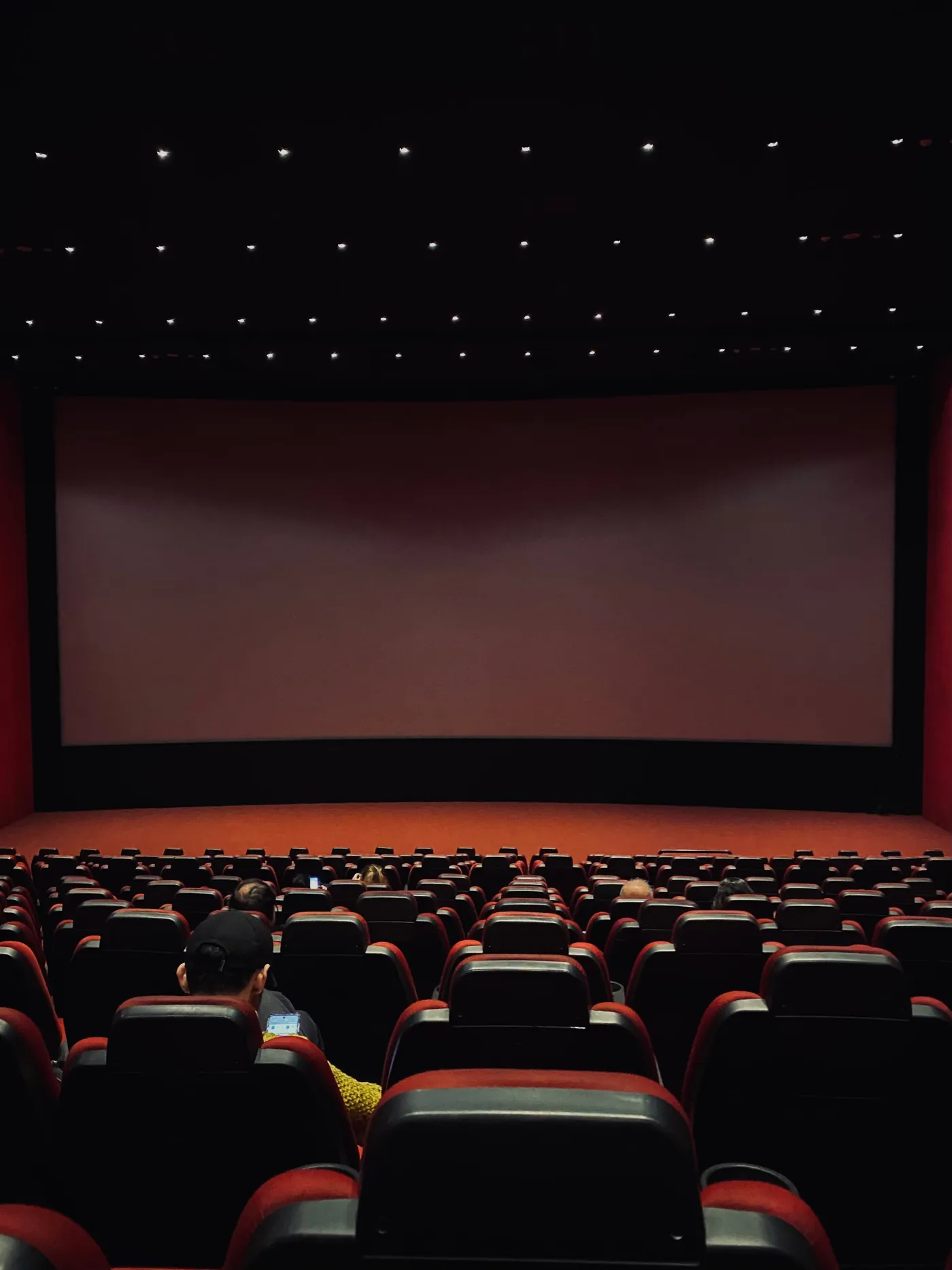
A cinema auditorium: rows of red seats facing a large screen, with small lights across the ceiling.
A cinema auditorium.

Unlike traditional surround sound systems—which send audio to specific, fixed channels (like Left, Right, Center, Surround Left, Surround Right)—Dolby Atmos is an object-based spatial audio system.

How it works: Channels vs. Audio Objects

1. Traditional Surround Sound (Channel-Based)

Audio tracks are mixed for specific speakers (e.g., 5.1 or 7.1 channel setups).

If a sound moves from front to back, the mixer adjusts volume levels between the front and rear speaker channels.

Drag the sound between the front and rear speakers, and watch the two channel levels change.

2. Dolby Atmos (Object-Based)

Sounds are treated as individual “audio objects” (up to 128 simultaneous objects in professional mixes).

Sound designers can place and move each object anywhere in a three-dimensional virtual space using precise X, Y, Z coordinates.

Drag the ball to raise or lower it. Drag its ring on the floor to move it around you. With sound on, headphones help.

Height & Overhead Sound

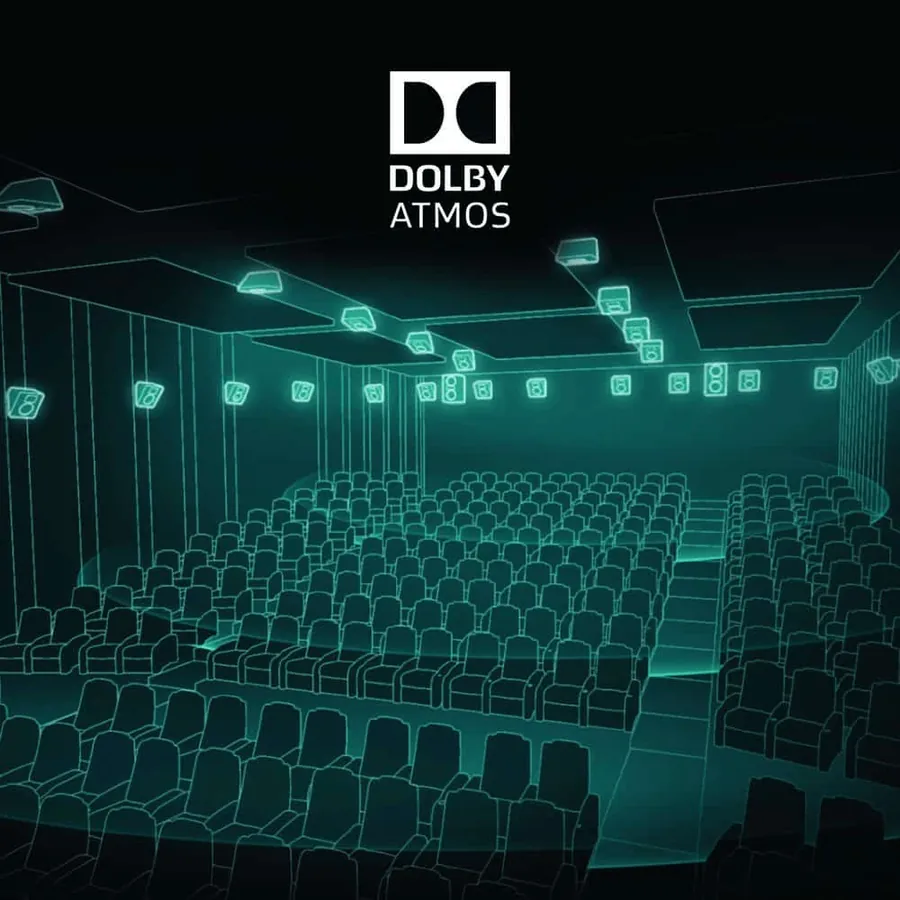
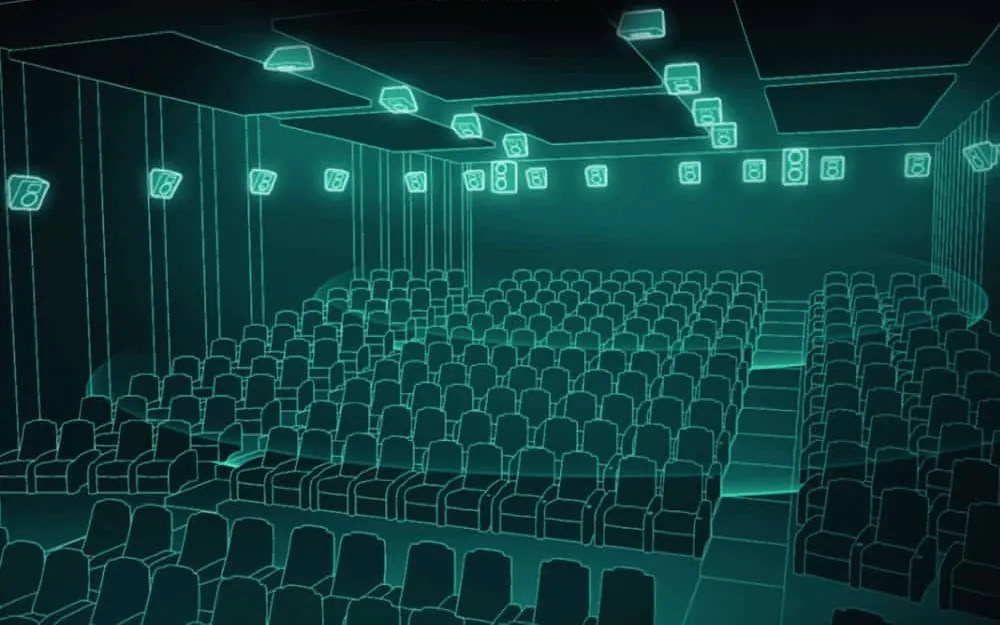
Atmos introduces verticality by placing speakers (or upward-firing speakers) above you, allowing sounds like rain, thunder, or a flying helicopter to actually pass over your head.

Illustration of a Dolby Atmos cinema, with speakers along the walls and across the ceiling above the seats.
Speakers above you. Overhead speakers in a Dolby Atmos cinema.

Real-Time Rendering

Because audio objects are defined by location coordinates rather than fixed speaker channels, a Dolby Atmos system uses a real-time audio renderer:

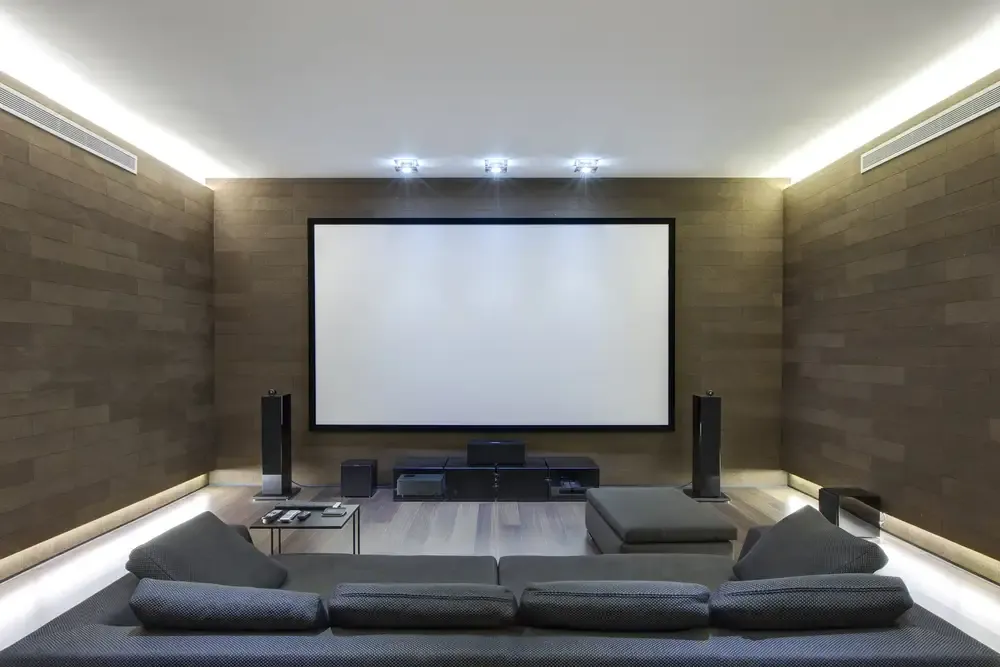
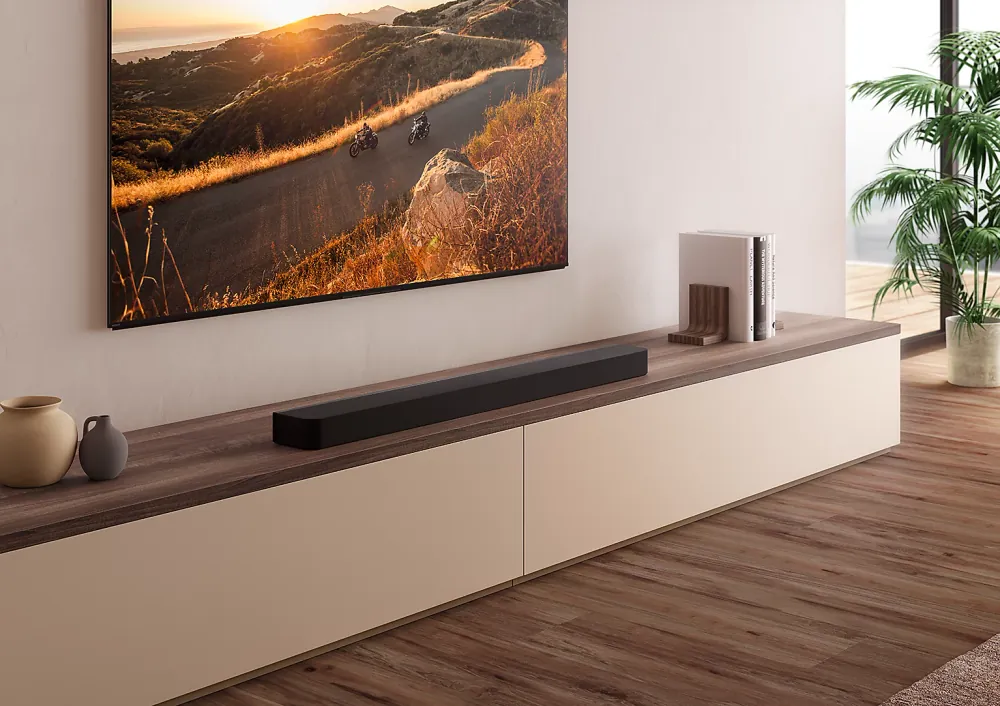
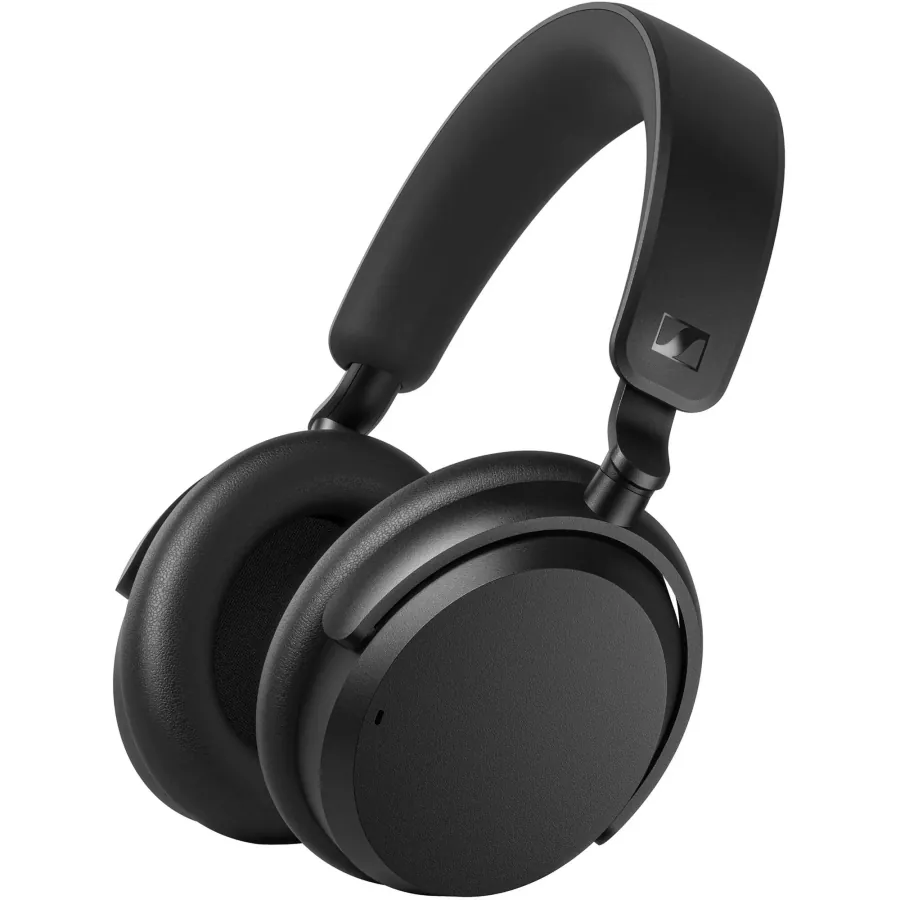
Whether you are listening on a 64-speaker commercial cinema system, a 7.1.4 home theater, a soundbar, or a pair of headphones (using spatial binaural rendering), the system dynamically calculates how to best reproduce the 3D sound environment for your specific setup.

Illustration of a Dolby Atmos cinema, with rows of speakers on the walls and ceiling.
Cinema 64-speaker commercial system
A home cinema room with a large screen, floor-standing speakers and a sofa.
Home theater 7.1.4 speakers
A soundbar on a low cabinet beneath a wall-mounted TV.
Soundbar A single speaker bar
A pair of over-ear wireless headphones.
Headphones Spatial binaural rendering

Key Applications

Cinema & Home Theater

Creates an immersive experience where sound moves seamlessly around and above the audience.

Music Production

Mixed specifically in Dolby Atmos Music to give listeners the impression of being inside the room with the instruments.

Gaming & VR

Enhances situational awareness by allowing players to pinpoint exact sound locations (e.g., footsteps overhead or behind).

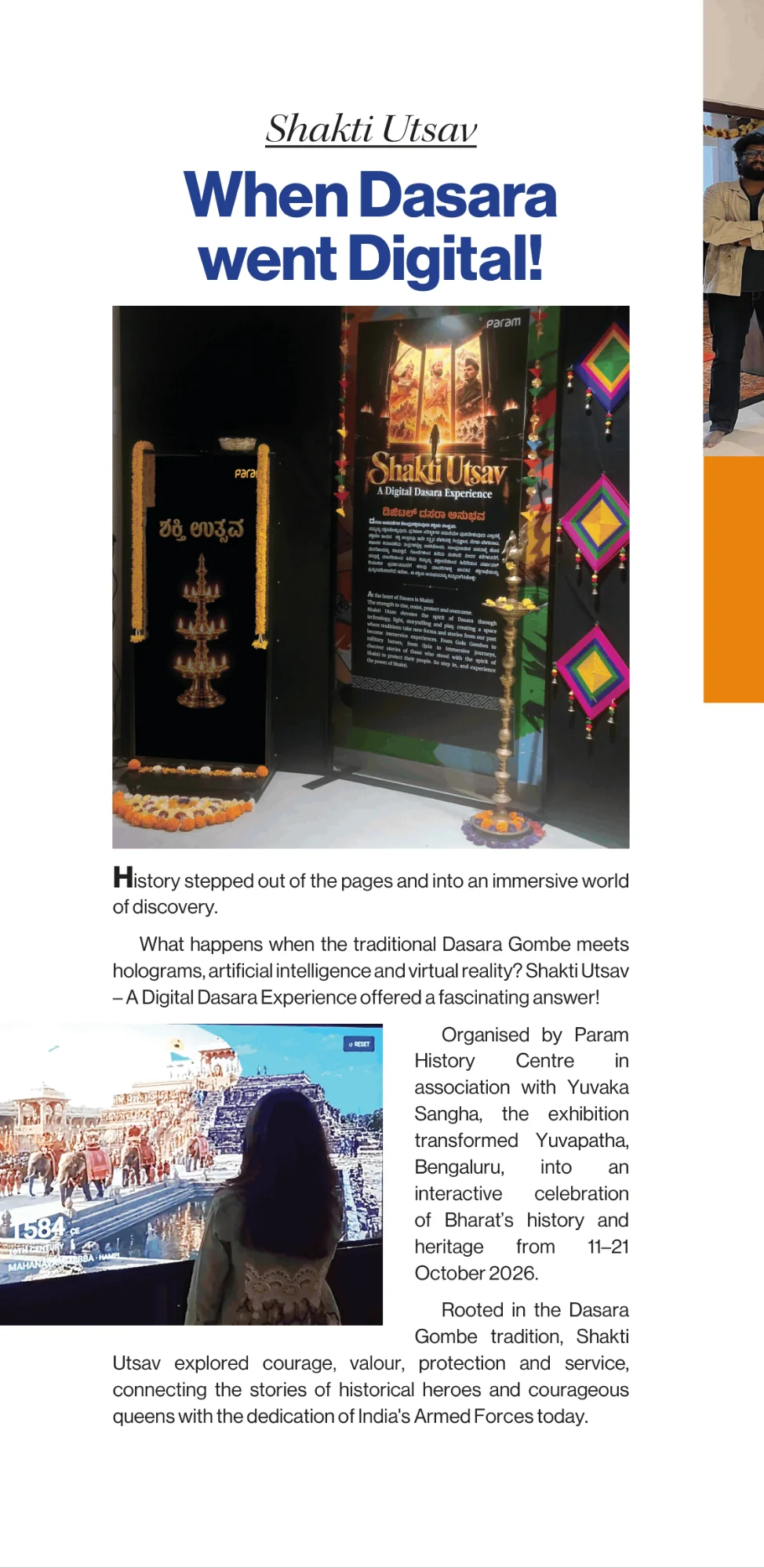
Page 12. Shakti Utsav: When Dasara went Digital! Photos of the exhibition entrance, with standees, a brass lamp, marigold garlands and paper kites, and of a visitor watching a digital recreation of a Dasara procession. The full text is below.
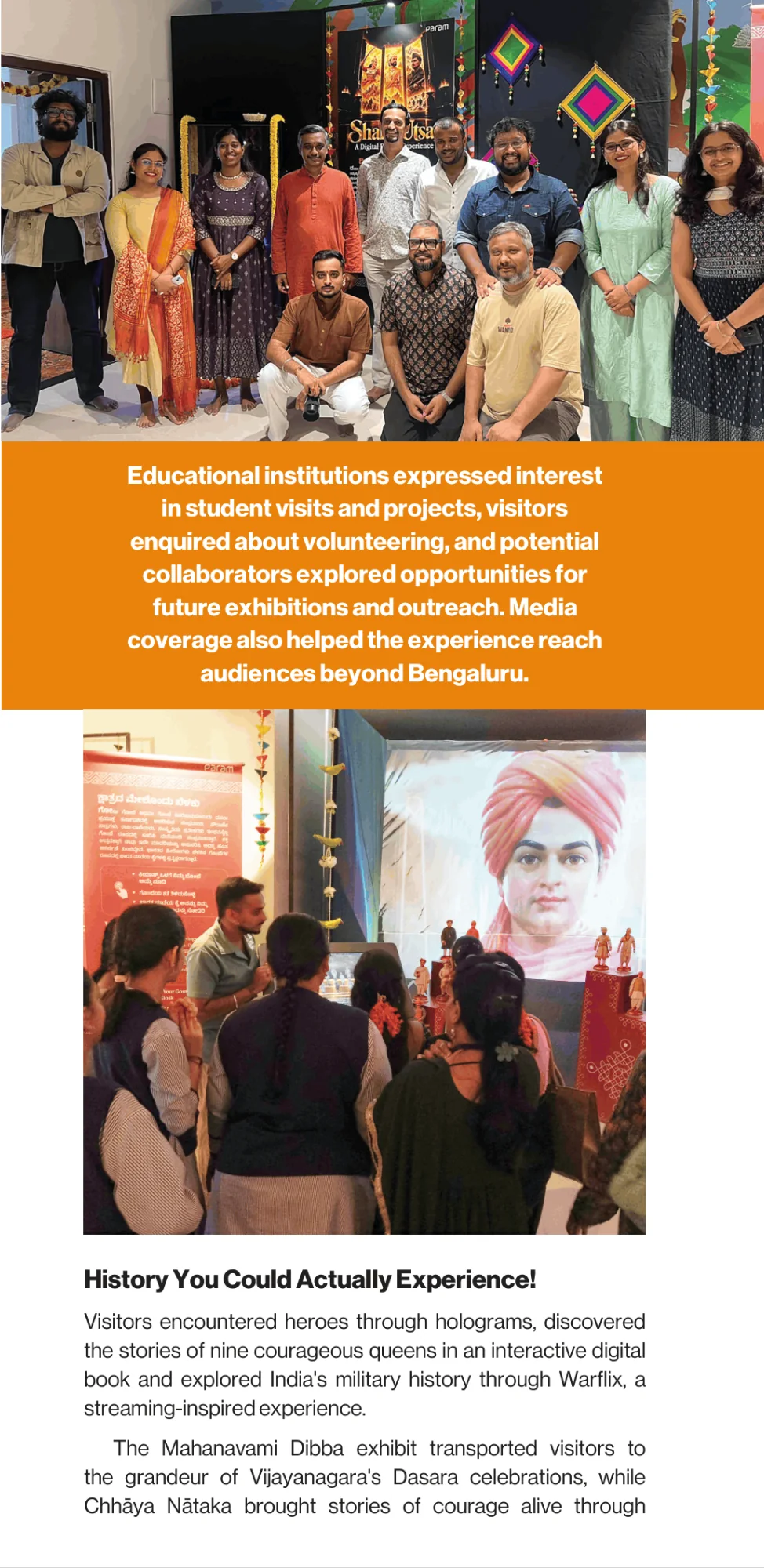
Page 13. Photos of the Shakti Utsav team in front of the exhibition and of students watching a hologram portrait. Includes the section ‘History You Could Actually Experience!’. The full text is below.
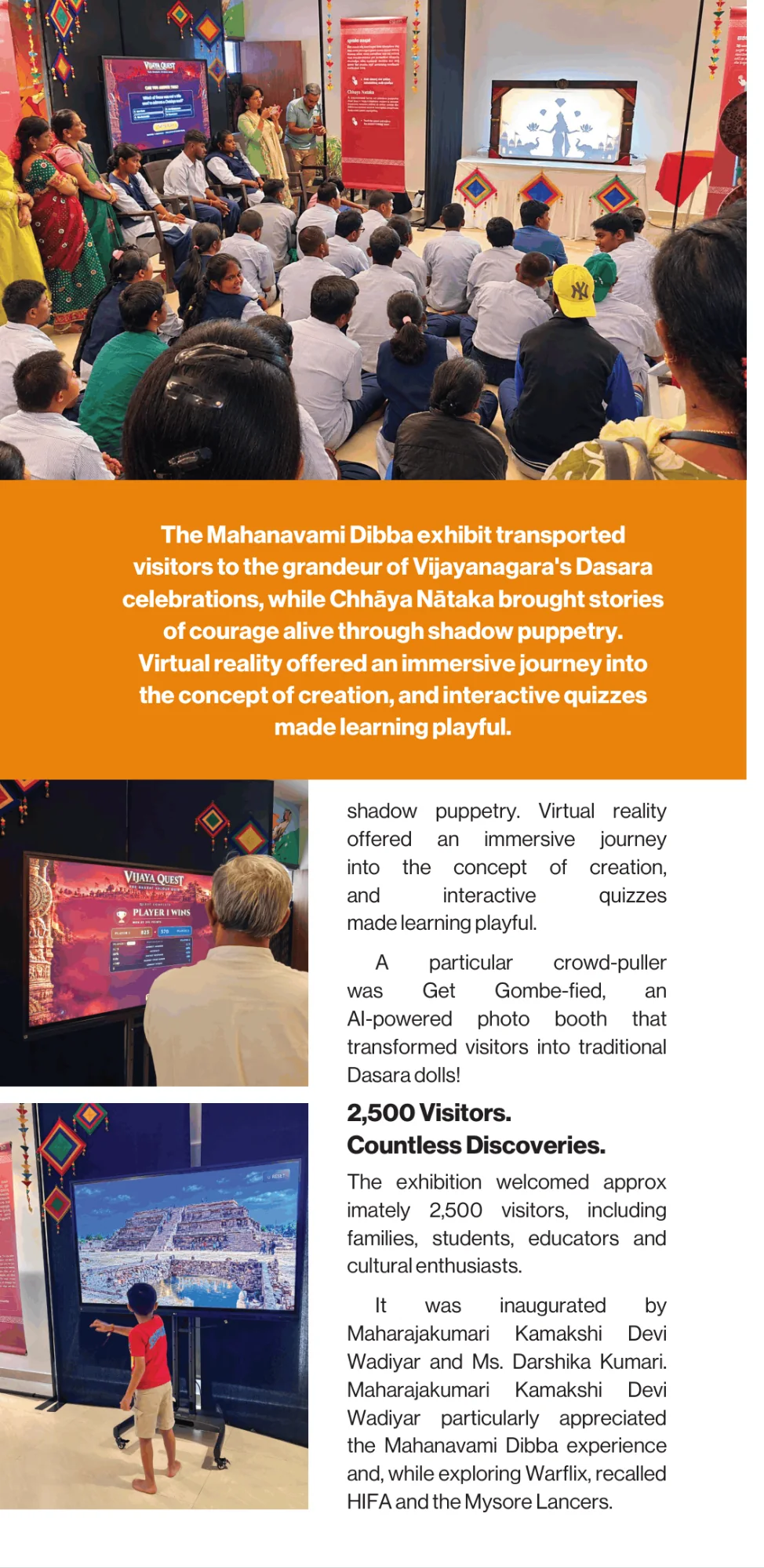
Page 14. Photos of students watching a shadow-puppetry screen, a visitor playing the Vijaya Quest quiz, and a child exploring an interactive screen. Includes ‘2,500 Visitors. Countless Discoveries.’ The full text is below.
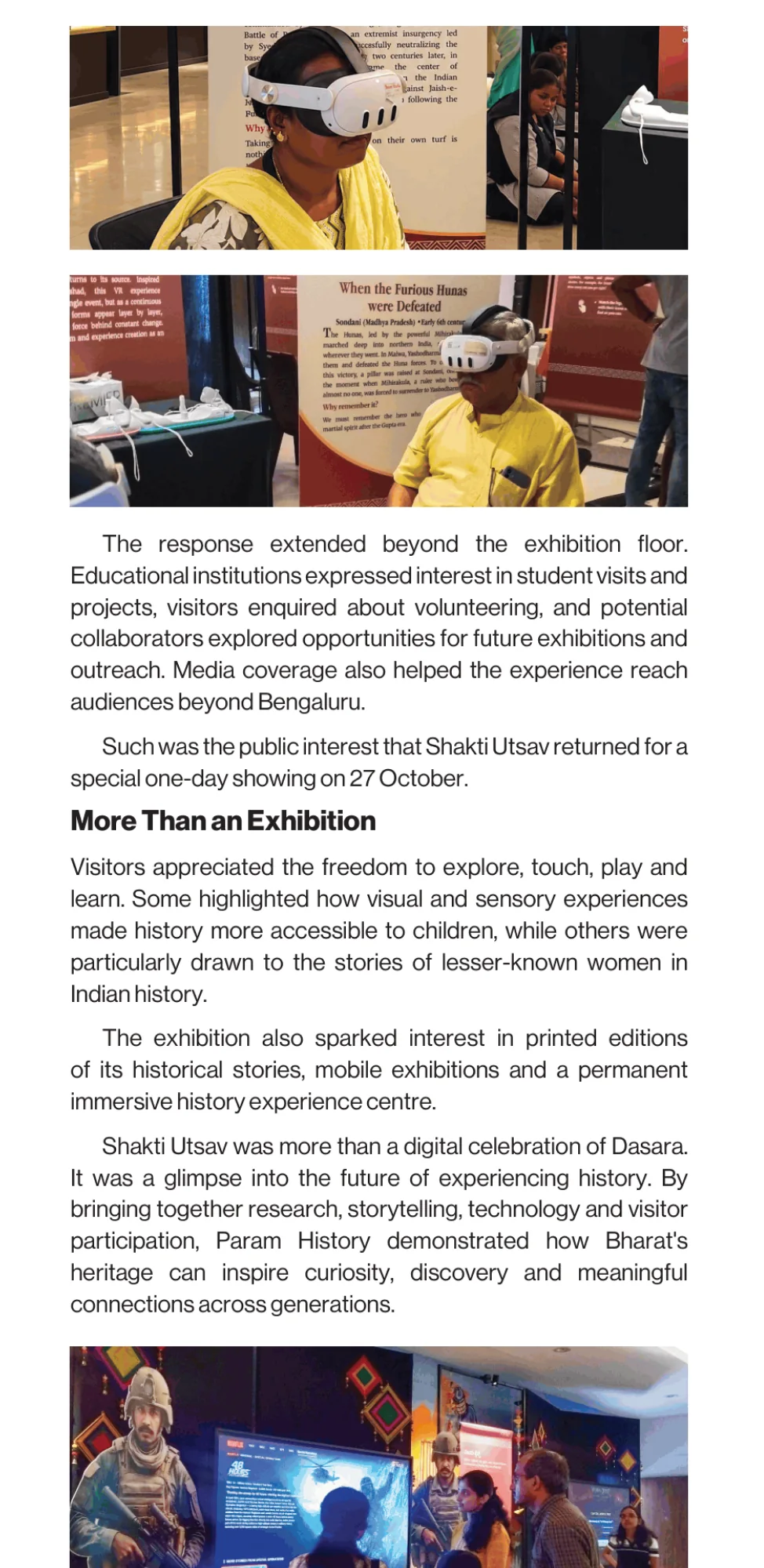
Page 15. Photos of two visitors wearing virtual reality headsets and of visitors at the Warflix exhibit. Includes ‘More Than an Exhibition’. The full text is below.
Read this recap as text

Shakti Utsav

When Dasara went Digital!

History stepped out of the pages and into an immersive world of discovery.

What happens when the traditional Dasara Gombe meets holograms, artificial intelligence and virtual reality? Shakti Utsav – A Digital Dasara Experience offered a fascinating answer!

Organised by Param History Centre in association with Yuvaka Sangha, the exhibition transformed Yuvapatha, Bengaluru, into an interactive celebration of Bharat’s history and heritage from 11–21 October 2026.

Rooted in the Dasara Gombe tradition, Shakti Utsav explored courage, valour, protection and service, connecting the stories of historical heroes and courageous queens with the dedication of India’s Armed Forces today.

History You Could Actually Experience!

Visitors encountered heroes through holograms, discovered the stories of nine courageous queens in an interactive digital book and explored India’s military history through Warflix, a streaming-inspired experience.

The Mahanavami Dibba exhibit transported visitors to the grandeur of Vijayanagara’s Dasara celebrations, while Chhāya Nātaka brought stories of courage alive through shadow puppetry. Virtual reality offered an immersive journey into the concept of creation, and interactive quizzes made learning playful.

A particular crowd-puller was Get Gombe-fied, an AI-powered photo booth that transformed visitors into traditional Dasara dolls!

2,500 Visitors. Countless Discoveries.

The exhibition welcomed approximately 2,500 visitors, including families, students, educators and cultural enthusiasts.

It was inaugurated by Maharajakumari Kamakshi Devi Wadiyar and Ms. Darshika Kumari. Maharajakumari Kamakshi Devi Wadiyar particularly appreciated the Mahanavami Dibba experience and, while exploring Warflix, recalled HIFA and the Mysore Lancers.

The response extended beyond the exhibition floor. Educational institutions expressed interest in student visits and projects, visitors enquired about volunteering, and potential collaborators explored opportunities for future exhibitions and outreach. Media coverage also helped the experience reach audiences beyond Bengaluru.

Such was the public interest that Shakti Utsav returned for a special one-day showing on 27 October.

More Than an Exhibition

Visitors appreciated the freedom to explore, touch, play and learn. Some highlighted how visual and sensory experiences made history more accessible to children, while others were particularly drawn to the stories of lesser-known women in Indian history.

The exhibition also sparked interest in printed editions of its historical stories, mobile exhibitions and a permanent immersive history experience centre.

Shakti Utsav was more than a digital celebration of Dasara. It was a glimpse into the future of experiencing history. By bringing together research, storytelling, technology and visitor participation, Param History demonstrated how Bharat’s heritage can inspire curiosity, discovery and meaningful connections across generations.

PARAM Science · Light & Sound · November 2026

Contents

  1. Article 01 Beyond what we see and hear
    1. The shrimp with a bubble gun
    2. A phone call on a sunbeam
    3. Krakatoa: The sound that went around the world
    4. When light slows to a crawl
  2. Article 02 What is Dolby Atmos?
    1. Channels vs. audio objects
    2. Height and overhead sound
    3. Real-time rendering
    4. Key applications
  3. Article 03 · Param History When Dasara went Digital!
    1. Shakti Utsav, pages 12–15
    2. Read the recap as text

Cover · Masthead and editorial note · Sound settings · Last page